How To Search for Fort Lauderdale Property Records
Before buying or investing in Fort Lauderdale real estate, it's smart to research a property's history and legal status. Property records act like a background check, helping you spot red flags, confirm ownership, and understand taxes before committing to a deal. Property records usually contain information such as the owner's name, property description, assessed value, exemptions, maps, flood zones, permits, mortgages, deeds, and liens. Property records are generally public records searchable online by anyone. By following the guide below, you can easily look up property records in Fort Lauderdale.
Broward County Records, Taxes, and Treasury Division

The Broward County Records, Taxes, and Treasury Division maintains all legally recorded property documents, including deeds, mortgages, liens, releases, easements, plats, and certified copies. The office maintains a searchable database accessible at the office location, where you can view indexes and images of recorded deeds. The database offers free basic searches and paid certified document requests. You can access the records at the Broward County Governmental Center at 115 South Andrews Avenue, Fort Lauderdale, FL 33301. The office opens from Monday through Friday from 8:30 A.M to 5:00 P.M.
Broward County Property Appraiser's Office

The Broward County Property Appraiser (BCPA) is responsible for maintaining the county's property database. The office provides property information, including parcel and folio numbers, current owner name, property description, property assessment values, exemptions and taxable values, sales history, and special assessments. The records are accessible online through the Property Search webpage. Users can search the database by name, address, or property ID number. Additionally, you can access the record in person at the Broward County Governmental Center at 115 South Andrews Avenue, Room 111, Fort Lauderdale, FL 33301.
City of Fort Lauderdale

The City of Fort Lauderdale Property Records Office maintains digital and microfilm records of building permits and plans for properties in Fort Lauderdale. You can contact them via email at PropertyRecords@fortlauderdale.gov or call (954) 858-8000. The office is open Monday through Friday from 8:00 a.m. to 4:00 p.m. Microfilm can be viewed and copied between 8:00 a.m. and 3:00 p.m. Some requests require an in-person visit. There are fees associated with copying the records.
Broward County Circuit Court

The Broward County Clerk of Courts maintains official court records, including foreclosure filings, probate cases, civil litigation, and related dockets that can affect property ownership. All property-related court records are filed at the Broward County Circuit Court and can be accessed online through the Case Search webpage. The portal allows you to search by party name, business name, case number, or citation number. Additionally, you can access the record in person at the Broward County Clerk of Courts office at 201 SE 6th Street, Fort Lauderdale, FL 33301. Copies are available for a small fee, while general searches and online viewing are free.
Fort Lauderdale Property Taxes
Property taxes are crucial to Fort Lauderdale's economy, funding essential services like schools, police, fire, libraries, parks, roads, and local government operations. Property taxes are assessed annually by the BCPA based on January 1 valuations. Once values are certified in October, the Tax Collector mails bills each November 1 for the new fiscal year. Taxes are typically due by March 31 and delinquent April 1, when a 3% penalty, 1% monthly interest, and collection fees apply. After about two years of nonpayment, the county issues tax certificates, and if unredeemed, can sell the property at a tax deed sale. Property owners in Fort Lauderdale can pay property taxes online, by mail, phone, or in person at 115 South Andrews Avenue, Room A-100, Fort Lauderdale, FL 33301. If you choose to pay your taxes by mail, you can send the check to Broward County Tax Collector, P.O. Box 105048, Atlanta, GA 30348.
![]() Assessments
Assessments

The Broward County Property Appraiser's Office is responsible for assessing all taxable real estate in Fort Lauderdale. Per state law, properties in Fort Lauderdale are revalued every January 1 to set the taxable value. Market value is estimated using the Sales Comparison for most homes, the Cost Approach for replacement cost minus depreciation, and the Income Approach for rentals or commercial property. Generally, assessed value aims to match fair market value, but can differ due to exemptions or statutory caps: 3% or CPI (lower) for homestead and 10% for non-homestead.
If you disagree with the proposed market value, you can request an informal review or file a petition with the Value Adjustment Board (VAB) within the deadline printed on the TRIM notice. The petition is typically filed with the Clerk of the VAB at the Broward Government Center, 115 South Andrews Avenue, Room 120, Fort Lauderdale, FL 33301. You can call the VAB at (954) 357-7205 or (954) 357-5367 for general inquiries and to obtain the VAB petition form.
![]() Appraisals
Appraisals

In Fort Lauderdale, Florida, property assessments function in the same way as appraisals. They are both designed to determine the fair market value of a property by comparing it to recent sales of similar homes or buildings in the surrounding area. When it comes to unique properties, the county relies on a professional appraiser to provide a more precise valuation. Beyond their use for property tax purposes, you can use appraisals in many other areas. Estate planners use them when determining the value of assets, courts may require them in probate or divorce cases, and lenders rely on them to approve mortgages or refinancing.
![]() Tax Rates
Tax Rates

Fort Lauderdale's median effective property tax rate stands at 1.44%, which is higher than both the U.S. median at 1.02% and Florida's average of 1.14%. A typical Fort Lauderdale homeowner pays around $3,305 in property taxes each year. The average homeowner in Florida pays $2,286, reflecting the city's higher property values and its above-average tax rate. Here is a breakdown of property tax rates in other Florida counties:
- Hillsborough County 1.247%
- Miami-Dade County 1.41%
- Palm Beach County 1.34%
- Orange County 1.16%
- Lee County 1.21%
- Duval County 1.14%
- Alachua County 1.03%
- Pinellas County 1.08%
- Brevard County 0.95%
- Polk County 1.16%
- St. Lucie County 0.99%
![]() Exemptions
Exemptions

Property taxes in Fort Lauderdale can be expensive for some households. To assist residents in affording property taxes, the BCPA office offers exemptions for eligible homeowners. Exemptions aim to reduce the taxable value of a property and ease the annual tax burden while protecting homeowners' fixed income. Some exemptions open to homeowners across Fort Lauderdale include:
- Homestead Exemption
- Additional-Low Income Senior Exemption
- Disability Exemption for Blind Persons
- Disability Exemptions
- Exemption for Widowed Persons
- Veteran's Disability Exemption
- Deployed Military Exemption
If you are eligible to access exemptions in Fort Lauderdale, you can contact the Broward County Property Appraiser.
Fort Lauderdale Building Permits/Inspections
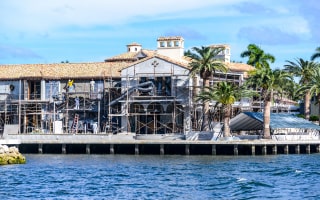
Most construction projects in Fort Lauderdale, including new buildings, additions, remodels, roofing, and certain repairs, require a building permit. Additionally, after the construction work is completed, city inspectors must check that it meets safety and building code standards. Building permits in the city are handled by the City of Fort Lauderdale's Development Services Department (DSD). The office provides for online application of building permits using LauderBuild. The platform allows you to submit digital building permit applications, schedule inspections, upload documents, pay fees online, and review permit status. You can also apply for building permits in person at the DSD office located at Greg Brewton Center, Development Services Department, 700 NW 19th Avenue, Fort Lauderdale, Florida 33301.
Building permit approval times vary; however, the DSD strives to review all applications within 30 days. The following categories of permits are available in Fort Lauderdale:
General Building Permits
- New Constructions: Building permits are required for new construction projects
- Additions: A permit is required when adding extra rooms or space to an existing structure
- Remodels: All interior or exterior changes, such as kitchens, baths, or layout updates, require a building permit
- Demolitions: A permit is needed to tear down all or part of a structure safely.
- Others: Other construction projects requiring permits in Fort Lauderdale include decks, sheds, and garages.
Specialized Permits

- Structural Permits: It is required for foundation work and major structural repairs, such as fencing, accessory structures, re-roofing, communication tower, shutters, and concrete restorations, to ensure safety.
- Electrical Permits: Electrical permits are needed for wiring, service upgrades, Solar PV, meters, or other electrical system changes.
- Plumbing Permits: A plumbing permit is required for any structure that involves fixture replacements, new water lines, irrigation systems, storage tanks, water heater extraction or changeout, or a sewer cap installation.
- Mechanical Permits: It is required for heating, cooling, and ventilation systems such as HVAC new installations or changeouts, spray booth, and ductwork.
When applying for any of these permits, you must submit the proper documentation (building plans, blueprints, contractor licenses, materials lists, etc.). You must also pay the appropriate fee.
Building inspections are part of the permit process, and they ensure that the work complies with local building and safety codes. You can schedule an inspection through the online portal or in person at the office during regular business hours.
Real Estate in the City of Fort Lauderdale
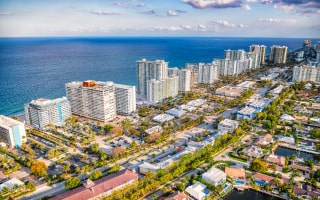
Fort Lauderdale has become a competitive destination for real estate investment due to the city's booming tourism industry, thriving marine sector, and growing tech scene, creating new jobs and boosting wages. With no state income taxes and competitive property taxes, investors enjoy healthy net returns.
Fort Lauderdale's lively cultural scene, waterfront lifestyle, and ongoing infrastructure upgrades make it appealing to live, work, and invest. The city has a population of about 184,263 residents. There are 99,631 housing units with over 81,000 units occupied, reflecting a healthy market with an 82% occupancy rate. The median household income is around $80,000, with many households earning more, supporting the ownership and rental market.
Fort Lauderdale has many housing options. Home buyers, investors, and renters can find condos in both low and high-rise buildings, especially downtown and waterfront areas. Townhouses and apartments are common in busy urban areas. Single-family homes range from historic Victorian and mid-century styles to newer builds, with some Cape Cod-style designs.
The median sales price in Fort Lauderdale is about $489,900, down 4.6% from the previous year, with homes selling within 100 days on the market. However, home prices vary across the city as follows:
- Flagler Village $520,000
- Victoria Park $890,000
- Rio Vista $1,200,000
- Downtown Fort Lauderdale $725,000
- Sailboat Bend $516,096
- Harbour Beach $6,500,000
- Progresso Village 0 $472,755
- Flagler Heights $462,148
- Middle River Terrace $400,000
The Fort Lauderdale housing market is experiencing high inventory, while demand has cooled. Houses stay on the market for about 60-85 days before sale, depending on the neighborhood. Condos are showing the biggest slowdown, having more listings and fewer sales. Conversely, single-family homes, especially properties with water access, still sell quickly and draw stronger offers. Overall, Fort Lauderdale's real estate is stabilizing, leaning towards a buyer's market.