How To Search for Tampa Property Records

If you love beautiful beaches, waterfront properties, and still want to enjoy a year-round warm climate, consider buying real estate in Florida. However, it is best to conduct due diligence before purchasing any property in the state. One way to do this is by searching public property records. A typical property record includes information such as property value, ownership details, legal description, tax details, building features, and transfer/sales history. Anyone may view or access copies of Tampa property records because they are public documents. However, it is essential to know where to check when searching for these records. Below are some resources to help you find property records in Tampa, FL.
Hillsborough County Property Appraiser's Office

The Hillsborough County Property Appraiser (HCPA) is responsible for assessing real properties within the county, including those in Tampa City. It also maintains up-to-date information about such properties. You may look up vital information on a property through the HCPA's Property Search tool using the owner's name, address, parcel number, or folio number as the search parameter. The search will reveal property ownership details, sales history, legal descriptions, and property valuation. Alternatively, you may search for Tampa property records in person by visiting the HCPA's office at County Center, 15th Floor, 601 E. Kennedy Boulevard, Tampa, FL 33602-4932.
Hillsborough County Clerk of Court and Comptroller

You can find Tampa property records through the Official Records Public Search tool offered by the Hillsborough Clerk of Court and Comptroller. With this tool, you may search property records by a person's name, book/page number, or document type. When using a name search, enter a personal or business name associated with the property owner(s), which must be at least three characters long, and provide other important details. You will find information related to mortgages, foreclosures, liens, and deeds in the search results. If you do not wish to use this online system, you may also search for property records in person by visiting the Hillsborough Clerk or Court and Comptroller's office at 419 Pierce Street, Room 140, Tampa, FL 33602.
Hillsborough County Tax Collector's Office
The Hillsborough Tax Collector's Office maintains records of property tax payments in Tampa City. It maintains a Property Tax Search website, which you can use to find certain information about any property in the city using address, name, or real estate account number as your search input. After performing a search, you will find information such as parcel details, Ad Valorem taxes, non-Ad Valorem assessments, annual bill, sales history, construction details, permits details, GIS map, and building characteristics.
City of Tampa Public Records Center
You can search for Tampa property records by submitting a record service request through the Tampa Public Records Center. While you may create an account before submitting your request, this system allows you to find property records anonymously. However, it is best to create an account so you can track and monitor the status of property records requests.
Tampa Property Taxes
Property taxes are one of the largest revenue sources for Tampa, keeping the city's public services functioning. They fund public schools, maintain infrastructure, fund local government services, and support varying community programs. The Hillsborough County Property Appraiser's office (HCPA) determines the value of properties in the city each year for taxation purposes. Once the assessed value of each property in Tampa is determined, the County Tax Collector calculates the actual bills and mails them to property owners every November 1st, which is the first due date.
You can enjoy the following discounts for paying your property tax early in Tampa, depending on when you do: 4% discount if you pay in November, 3% discount if you pay in December, 2% discount if you pay in January, and 1% discount if you pay in February. The final due date for paying annual property taxes is March 31st of the following year. If you do not pay by April 1st, it becomes delinquent, which typically incurs interest charges. Where property taxes are left unpaid for too long, the Tax Collector's Office will place a lien on the property and foreclose it, selling the property at auction after 2 years to clear the back taxes.
There are multiple ways to pay a property tax in the City of Tampa. You may pay online using an e-check or a debit/credit card. Alternatively, you can pay by mailing a money order or a check with the payment stub to the Hillsboro County Tax Collector atP.O. Box 30012, Tampa, FL 33630-3012.
![]() Assessments
Assessments

The Hillsboro County Property Appraiser's office is responsible for property assessments in Tampa. It determines property values and provides assessment data to the Tax Collector's office, which then mails tax bills to property owners. The HCPA uses varying methods to assess the values of properties, depending on the property type. These include the cost approach (for unique or newer properties), comparable sales approach (comparing similar properties or recent sales in an area — typically for homes), and income approach (for commercial properties).
In Tampa, all properties are re-assessed annually (as of January every year), and by August, the HCPA mails notices of proposed property taxes, known as TRIM (Truth in Millage) notices, to property owners. If you believe your property is over-assessed and disagrees with your tax assessment, contact the HCPA and provide solid evidence. If you are still not satisfied afterward, file a formal petition with the Hillsborough County Value Adjustment Board (VAB) within 25 days of receiving the TRIM notice.
![]() Appraisals
Appraisals

Tampa assessments work similarly to appraisals but serve different purposes. A property appraisal helps determine the current fair market value (FMV) of a property by using comparable data from the locality. Unlike a property assessment, which determines the taxable value of a property for property tax purposes, a property appraisal determines the market value of a property for specific purposes, such as selling a home, securing a loan, or refinancing a home. Whenever required, the county calls licensed appraisers to help determine the fair market value of property. Investors, lenders, sellers, insurance companies, and courts use property appraisals to value real property for specific purposes in Tampa.
![]() Tax Rates
Tax Rates

The median effective property tax rate in Tampa, Florida, is about 1.23% of the property's assessed (taxable) value. This is higher than the state's median of approximately 1.10% and the national median of about 1.02%. The average property tax payment in Tampa is approximately $3,236, which is significantly higher than the national median of $2,400, as well as Florida's median annual tax bill of about $2,386.
See how the median effective property tax rate in Tampa compares to some counties in Florida:
- Miami-Dade County 0.82%.
- Broward County 0.94%.
- Palm Beach County 0.88%.
- Orange County 0.78%.
- Seminole County 0.69%.
- Marion County 0.75%.
- Nassau County 0.72%.
- Homes County 0.51%.
- Duval County 0.77%.
- Baker County 0.62%.
- Glades County 1.01%.
- Clay County 0.73%.
![]() Exemptions
Exemptions

The property tax rates in Tampa, Florida, are moderately high. Thankfully, Hillsborough County offers some exemptions to help individuals who may have difficulty paying their annual property taxes. While these exemptions and reductions do not always eliminate tax bills, they can reduce taxable values. The available exemptions in Tampa include the following:
- Homestead Exemption: This reduces taxable value by up to $50,000 if your Florida home is your primary residence.
- Disabled Veteran's Exemption: You may enjoy a full or partial property tax exemption if you are a disabled veteran or a surviving spouse of a disabled veteran.
- Blind or Disabled Persons' Exemption: Reduces the assessed value by $500.
- Widowers/Widows Exemption: Reduces the assessed value by $500.
- First Responders' Exemption: For totally or permanently disabled firefighters, police, and Emergency Medical Technicians (EMTs).
You can apply for any of these property tax exemptions in Tampa by contacting the Hillsborough County Property Appraiser.
Tampa Building Permits/Inspections
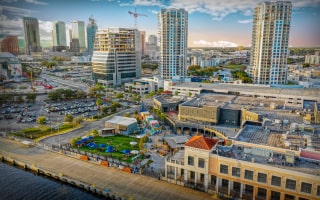
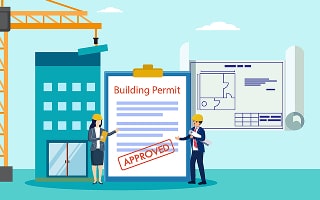
All new building constructions, repairs, alterations, and demolitions require a building permit and subsequent inspections in Tampa. You can get one from the City of Tampa Construction Services Division. However, cosmetic work like tiling, painting, cabinets, and flooring replacements, as well as any other minor work that does not require electrical or plumbing changes, will not need a permit. You can apply for a permit through the Citizen Access Portal, one of the city's websites. If you prefer to apply for a Tampa building permit in person, you can visit the Construct Services Division's office at 1400 N. Boulevard, Tampa, FL 33607.
The following types of building permits are available in Tampa, FL:
General Building Permits
- Commercial Building Permits: Needed for businesses, mixed-use buildings, triplexes, condominiums, and multi-family apartments.
- Residential Building Permits: Required for duplexes and single-family residences, and various remodeling projects, including fences, additions, roofs, and pools.
- Trade Permits: Needed for specific trades in construction, such as gas, electrical, mechanical, and plumbing work.
- Right-of-Way Permits: Required for any construction or maintenance work within public city right-of-way, such as utility infrastructure, driveways, and sidewalks.
Specialty Permits

- Demolition Permits: Required for demolishing structures.
- Foundation Stabilization Permits: Required for underpinning or pier installation when repairing compromised foundations.
- Electric Shutter Permits: Required for installing electric shutters.
- Window-Door Replacement Permits: Required to replace doors or windows with changes in size.
- State-Sealed Modular Permits: Needed to install pre-fabricated modular units.
- Seawall and Docks Permits: Required to construct waterfront features, particularly in flood zones.
When applying for any of these permits, you must submit the proper documentation (building plans, blueprints, contractor licenses, materials lists, etc.). You must also pay the appropriate fee.
Building inspections are part of the permit process, and they ensure that the work complies with local building and safety codes. You can schedule an inspection through the online portal or in person at the office during regular business hours.
Real Estate in the City of Tampa

Tampa is home to Florida's oldest and the world's largest Spanish restaurant, the Columbia Restaurant. The city's Bayshore Boulevard is widely recognized as the longest continuous sidewalk in the world, stretching approximately 4.5 miles along the bay. Every year, Tampa draws hundreds of thousands of people through a massive pirate-themed festival popularly called Gasparilla, where a pirate invasion takes over the city.
Tampa is Florida's third-largest city. It has a population of approximately 392,800 residents and about 188,160 housing units. At least 160,520 of the housing units are occupied. About 50.2% of these are owner-occupied, while 49.8% are renter-occupied. The city's local real estate market offers a wide range of housing options, including suburban single-family homes, condos, townhomes, waterfront properties, and historic bungalows. Popular home styles include Ranch, Contemporary, and Victorian styles.
The average price of a house in Tampa is $375,670, which is 4.7% down compared to the previous year. The median price per square foot is $291. While the average home price in the city is not overly high, it is also not among the most affordable in the U.S.
In Tampa, FL, house prices vary greatly depending on the neighborhood where you live. See some examples below:
- Downtown Tampa $491,110
- Ballast Point $578,760
- New Tampa $490,420
- Forest Hills $336,235
- South Howard $495,150
- East Tampa $264,170
- Old Seminole Heights $379,120
The Tampa, Florida, real estate market is leaning towards a buyer's market. There are more sellers than buyers, a slight reduction in home prices, and increasing inventory. Also, the median days on market has increased to approximately 45 days, up from around 26 days in the past years. Although the city's average home price is competitive, it is notably more affordable than many high-cost metro areas. Tampa remains a compelling option if you want a decent and relatively affordable home with urban amenities and a strong job market.